 Success-Plan Services
 Brian Senese
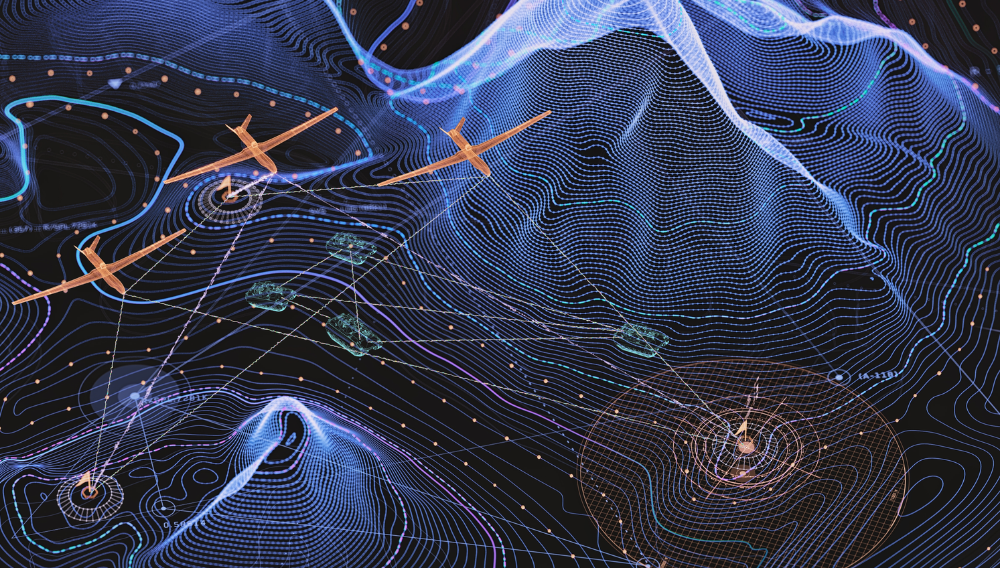
Artificial intelligence has become the headline technology in modern unmanned aircraft. Every week brings news of smarter drones capable of object recognition, autonomous navigation, and coordinated missions. But while AI receives most of the attention, another technology may prove even more important to the future of autonomous swarms: the communications architecture that allows dozens of intelligent aircraft to function as a single system.
Today's tactical swarms are becoming increasingly sophisticated. However, many still depend on centralized coordination. Small groups of drones often rely on a ground control station or an airborne "mothership" to assign tasks and distribute information. While effective for today's operations, this architecture creates a natural limitation when swarm size and mission complexity increase. As swarms evolve from a handful of aircraft to dozens, or eventually hundreds of autonomous platforms, the communications model becomes increasingly important.
For instance, point-to-point messaging has served unmanned systems well for many years. MAVLink, for example, has become the industry standard for communicating with PX4 and ArduPilot flight controllers because it is lightweight, efficient, and exceptionally well-suited for vehicle command and telemetry. Swarming, however, introduces a new level of complexity. Autonomous drones, for example, continuously share target tracks, formation positions, sensor observations, mission assignments, vehicle health, battery status, and environmental awareness.
In essence, each drone is simultaneously publishing as well as consuming information amongst members of the swarm. As a result the data demand placed on the system is formidable.
A Data-Centric Approach
Managing information flow using explicit point-to-point connectivity becomes increasingly difficult as the swarm size increases. Adding additional participants can quickly create entangled communication relationships, as well as increase required network bandwidth that is precious in contested environments. The architecture must scale without forcing developers to continually redesign who communicates with whom or flooding constrained networks with unnecessary data. This is the type of distributed data-sharing problem that data-centric architectures, such as those based on the Data Distribution Service (DDS®) standard, are designed to address.
Rather than sending messages directly to specific drones, DDS allows participants to publish complex data sets agnostic to their recipient. Any authorized drone can receive data of interest by subscribing to it. Irrelevant data (that isn’t subscribed) is automatically filtered. This is a data-centric approach. For example, a reconnaissance drone can publish target detections. Nearby strike drones subscribe to those detections. Formation controllers subscribe to neighboring position updates. Mission software subscribes to platform health, while collision avoidance algorithms receive only local traffic information. Applications remain independent (or loosely coupled) using the DDS databus which automatically manages node discovery and then supports subsequent data delivery.
Discovery is an automatic process through which new participants are found and through which connectivity is established. It enables selective “Topic” (or data) subscriptions, so each drone receives only relevant information rather than every message on the network. Another aspect of DDS is its use of Quality of Service (QoS) policies which determine data flow through the network. Critical command information, for example, may require reliable delivery, while high-rate position updates may prioritize lower latency using best-effort delivery. This allows the architecture to treat data according to its mission importance rather than treating every message the same – particularly important when network resources are constrained.
Inside the Communications Architecture
The same communications architecture that enables swarming can also offer significant advantages inside every modern drone. Even Group 1 and Group 2 aircraft are no longer simple flight controllers with cameras attached. Such devices increasingly resemble airborne computing platforms running Linux, AI inference engines, mission applications, computer vision, sensor fusion, navigation, payload management, and health monitoring simultaneously. These software components continuously exchange data with one another, creating many of the same distributed communications challenges found in the swarm itself.
Historically, these sophisticated software architectures were impractical because embedded processors lacked the memory and computing resources to support them. Modern System-on-Chip devices have changed that equation. Platforms such as Qualcomm's QRB5165 now provide multicore CPUs, GPUs, dedicated AI accelerators, and up to 8 GB of memory, allowing Linux, DDS, computer vision pipelines, and mission software to operate concurrently on even small tactical aircraft.
That hardware evolution has created an important architectural opportunity. Rather than using different technologies for inter-drone and intra-drone communication, developers can build both the swarm and the onboard software around the same data-centric DDS foundation. This simplifies the overall system architecture while reducing integration overhead. Sensor data, AI detections, navigation updates, mission commands, and vehicle health information can flow through a common middleware architecture from subsystem to subsystem and from aircraft to aircraft.
The future of autonomous swarms may likely be influenced by more powerful AI processors. But intelligence alone does not create cooperation. As drones become increasingly autonomous, success will depend on communications architectures that allow intelligent platforms to share information, adapt collectively, and operate without centralized control. Communication software such as RTI Connext, which is built on DDS, can provide that foundation – both within each aircraft and across the swarm – making it a natural fit for the next generation of autonomous unmanned systems.
Want to learn more? A new Autonomous Collaborative Teaming (ACT) Capability Brief from RTI dives deeper into some of the key aspects of modern swarming.
About the author: Brian Senese is a Senior Field Applications Engineer for Real-Time Innovations. He received his BSEE and MSEE from the University of Western Ontario, Canada and has over 30 years of experience in wireless communications development spanning real-time operating systems, protocols and RF. He has spoken publicly at conferences and is a published author of technical articles and books that serve to guide developers toward achieving results quickly.