 Success-Plan Services
 Darren Porras

The pace of innovation in surgical technology in 2025 is nothing short of transformative, as industry leaders continue to advance next-generation minimally invasive therapies. This year, I was invited to speak at a number of medical technology conferences, and one theme became clear: technology and collaboration are helping to reshape the future of surgical care.
Preeminent clinical leaders in this space such as Filipo Filicori, MD, Erik Wilson, MD, and Pieter De Backer, MD, PhD, have embraced this trend, and are leading the conversations and collaborations that are happening now that connect academia, industry, technology, and clinicians. By defining the vision of what is needed to bring meaningful innovation to clinical practices, the industry is moving forward with solutions that will transform the precision, effectiveness, and efficiency of clinical care.
In my travels, I observed these top trends:
Technology and collaboration are redefining surgical care.
Technology is actively reshaping the future of surgical care, with clinical leaders driving collaborations that connect academia, device manufacturers, and technology experts.
The operating room is evolving into an intelligent and connected digital ecosystem.
Surgical systems are becoming data streaming hubs. The integration of robotics, advanced visualization and intelligent edge-computing is enabling a new era of “physical AI” to augment precision, enhance decision-making and optimize workflows.
Data interoperability and integration is the key to surgical innovation and clinical impact.
Seamless interoperability and real-time data streaming across applications, devices, and networks is critical to unlocking data silos and realizing the potential of digital integration and AI-enabled systems.
Here is a chronological journey of my observations:
SAGES NBT (Houston, Texas, U.S., January 2025)
SAGES NBT, a unique conference that brings together industry and clinicians, is a remarkable gathering that focuses on the latest innovation in surgical technology and clinical practice. As a telling sign of the intersection of technology and surgical innovation, NVIDIA kicked off the first session, setting the tone for many discussions and examples of surgical AI use cases. Today, surgical co-pilots are able to ingest pre-operative and EMR data, along with intraoperative procedure and system data, to help guide surgical setup and provide real-time guidance for intraoperative workflows. Surgical systems now represent massive data streaming hubs where data collected from diverse sensors, instruments, cameras, and other devices can be leveraged to detect surgical leaks during surgery, monitor anesthesia and OR activity, and optimize electrosurgical energy delivery.

“AI- It’s a Connectivity Problem” - Here I’m discussing the critical need for data interoperability in AI-enabled surgical and robotic systems at SAGES NBT 2025.
Rapid advancements in edge computing, along with intelligent robotics and automation, are redefining what is possible in surgical care. Clinical teams are equipped to translate technology into solutions that will simplify and expedite clinical workflows, reduce complications, and advance clinical practice with robotic, vision, and AI-enabled technologies.
Surgical AI and Telesurgery Days (Ghent, Belgium, February 2025)
This conference effectively highlighted the rapid pace of innovation of surgical AI and telesurgery. ORSI hosted a number of live-streamed remote surgery demonstrations as well as AI-agents assisting live cases. The integration of robotics, vision, and intelligent edge-computing is enabling a new era of “physical AI” to not only augment technical precision, but also enhance decisions-making, and optimize workflow efficiency.
Today, we are witnessing a true revolution of the operating room, which is becoming a digital ecosystem based on streaming data and distributed applications and devices. For device manufacturers, this represents a drastic shift from siloed devices and data, to interoperable and integrated solutions. One aspect that is slowing down progress is the lack of data infrastructure to effectively and efficiently integrate different data sources, platforms, and applications across systems and programs.
Integration was also central to the theme of many current and future surgical AI use cases. Next generation surgical systems need to incorporate surgical video along with data streaming from multiple devices, instruments, and data sources. This integrated data stream can automate surgical tasks, provide real-time assistance, and determine and act on objective performance indicators. At ORSI, RTI gave an example of this integration, demonstrating a digital twin of a voice- and motion-controlled robotic arm that leveraged RTI Connext’s integration with NVIDIA Holoscan®.
Telesurgery continues to gain momentum with a number of new platforms demonstrating remote surgical capabilities. While there are a number of technical, process, and legal/regulatory challenges for the industry to work through, the capability to deliver remote care for a number of emerging use cases, including neurovascular and cardiac procedures, will benefit patients all over the world. In addition, this approach can reduce costs and help offset the growing shortage of surgeons.
Hamlyn Medical Robotics Symposium (London, UK, June 2025)
At this premier conference for Medical Robotics, Bill Peine, PhD showcased the exciting future of flexible, endoluminal robotics to bring less invasive treatments to new procedures. David Noonan, PhD shared the exhilarating startup journey of Moon Surgical and its innovative Maestro platform. Maestro® is already supporting hundreds of clinical cases, while also leading the application of Edge-AI in the operating room. All of this illustrates the power of AI, data, robotics, navigation, and visualization to usher in a new era of precision treatments across a number of use cases and procedures – all powered by surgical digital ecosystems.
The growing collaboration between academia and industry is exciting, as it allows the world's leading researchers to effectively and efficiently translate bench-top engineering breakthroughs into practical industry and innovative clinical applications.
The atmosphere in the exhibition area was electric, representing the intersection of industry, design partners and academia, all sharing ideas on how to advance technology not for technology’s sake, but for the real-world benefits to patients and clinicians. For example, NVIDIA hosted a pioneering workshop on training autonomous surgical robots, based on the NVIDIA Isaac™ for Healthcare development platform and using RTI’s data streaming technology to power simulation workflows and real-world examples that integrate AI policy with simulation and actuation.
I also had the pleasure of speaking with Mikael Brudfors, PhD at NVIDIA, at the Healing Through Collaboration workshop. In my talk, Designing for Scalable, AI-enabled Surgical Platforms, I highlighted the need for real-time data interoperability for integrated and AI-enabled surgical systems. I also shared how a data-centric communication framework simplifies and accelerates the development of new and legacy systems that integrate with NVIDIA’s Holoscan multi-modal AI sensor processing platform.
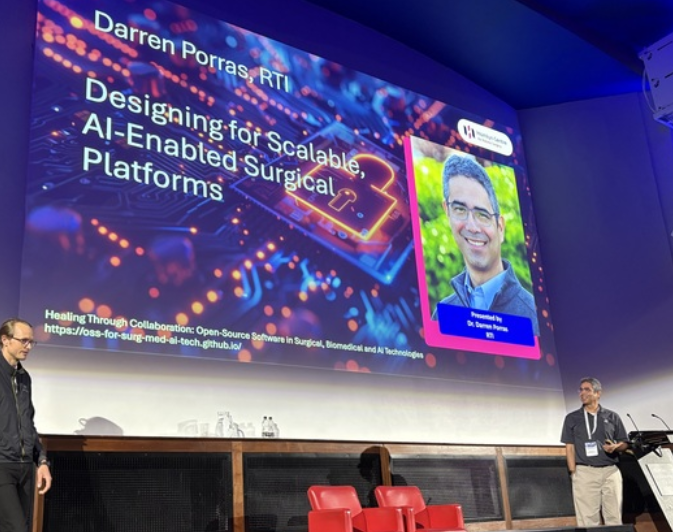
While in London, I had the pleasure of connecting with Professor Christos Bergeles at King’s College London and the London Institute of Healthcare Engineering, to see first-hand multiple cutting-edge projects that span interventional, telerobotic stroke, and endoluminal technologies.
Looking Ahead to 2026
In the coming year, I believe there will be an accelerated push for continued collaboration across industry, clinicians, and researchers that span both technology and clinical domains. These efforts will collectively and exponentially shape the future of connected and AI-enabled healthcare.
Data streaming from multi-modal data sources, across applications, devices, and systems, combined with edge AI, will revolutionize the precision of minimally invasive therapies and simplify clinical workflows. A new era in simulation will accelerate the design and optimization of systems that leverage AI training models.
Despite the rapid pace of technology innovation, significant challenges remain to accelerate the delivery of these surgical technologies into the clinic. New digital architectures are needed to simplify integration and unlock the data silos that result in costly product life cycles, impede innovation, and disrupt clinical workflows.
By tackling these key challenges head-on with interconnected digital ecosystems with an interoperable data infrastructure, a new era of innovative and AI-enabled solutions can be unleashed to re-define the digital OR ecosystem. At RTI, we are honored to play our part in making this happen.
For more information about RTI in healthcare, please visit www.rti.com/industries/healthcare
About the author:

Darren Porras is the Market Development Manager for Healthcare at RTI. With over 20 years of experience in the medical device industry and product development, he was a program manager at Medtronic for Surgical Robotics. Darren has also held program management and software development roles at Philips Healthcare and Integra Radionics spanning medical imaging, image-guided surgery, and cybersecurity.
Darren has a Bachelor of Science in Engineering from Duke University and Master of Science in Biomedical Engineering from the University of Alabama-Birmingham.