 Success-Plan Services
 Rob Proctor
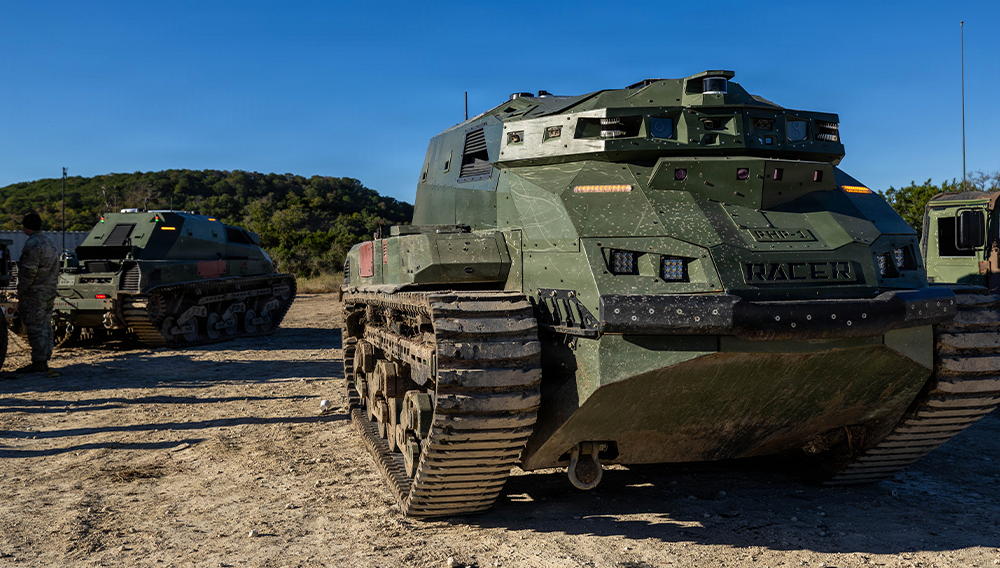
Robotic systems in Ukraine are exposing a coordination problem. Individual platforms can operate effectively in narrow roles, but coordinating large numbers of autonomous systems remains difficult. The challenge grows quickly as teams expand beyond a few platforms.
Much of the robotic employment seen in Ukraine today is effective in narrow, tactical contexts: logistics resupply, casualty evacuation, reconnaissance, and one-off strike missions. These systems work because they are simple, tightly controlled, and used in relatively static environments. But that same approach does not translate to large-scale, fast-moving, coordinated operations involving dozens or hundreds of autonomous systems.
The key insight is this: Scaling autonomy depends on coordination. As the number of platforms increases, systems must share intent, exchange state, and adapt to changing roles in real time.
Why Coordination Breaks First
As the number of unmanned systems grows, traditional command-and-control approaches break down. Point-to-point communications, stove-piped control software, and operator-centric workflows create bottlenecks that no amount of onboard autonomy can fully overcome.
This challenge was recognized long before today’s conflicts. As early as 2006, programs such as the Multi-robot Operator Control Unit (MOCU) demonstrated that controlling heterogeneous robots at scale required modular architectures, shared data models, and the ability to dynamically assign roles and responsibilities. What has changed since then is the operational urgency and scale of the problem.
Modern Conflicts Demand:
-
Hundreds or thousands of attritable systems
-
Operation under degraded or contested communications
-
Dynamic teaming and re-tasking at machine speed
-
Reduced cognitive burden on human operators
These requirements cannot be met by simply adding more autonomy to individual platforms. They require a data-centric coordination layer that allows systems to discover each other, share intent, exchange state, and adapt as teams, even when networks are unreliable.
Coordination Is a Data Problem
At its core, coordination is about who needs to know what, when, and under what conditions. This includes:
-
Mission intent and role assignment
-
Status, health, and capability reporting
-
Local and global situational awareness
-
Command delegation and authority transfer
-
Graceful degradation when links fail
These concerns belong at the architecture level. For military systems in particular, the wide-spread adoption of the Data Distribution Service (DDS®) standard happened in large part to address these concerns. Today, supporting real-time, many-to-many data exchange in distributed systems operating under constrained and unpredictable network conditions is what DDS does best. Its publish-subscribe model decouples producers and consumers of data, allowing systems to scale organically without brittle point-to-point integrations.
In essence, DDS provides the coordination that large-scale autonomous systems require.
From Demonstration to Reality
In 2024, the Defense Innovation Unit (DIU) issued a call for Autonomous Collaborative Teaming (ACT), explicitly recognizing the need to coordinate hundreds or thousands of unmanned assets across disrupted networks. And RTI’s demonstration for this effort illustrated how RTI Connext software can support dynamic team formation, mission-driven communications, and bandwidth-aware data sharing, including integration with operational tools such as WinTAK. The idea being that the demo would be able to reflect real operational requirements:
-
Platforms automatically discovering command nodes
-
Operators forming and dissolving teams dynamically
-
Local peer-to-peer coordination within a team
-
Controlled data flow across constrained WAN links
-
Systems returning to an idle pool ready for re-tasking
The challenge is coordination at scale. Current conflicts show that autonomous systems must share data, synchronize actions, and operate across distributed networks rather than functioning independently.
Proven at Scale, Ready for Robotics
Connext of course is not new to defense operations. Built on the DDS standard, Connext already underpins some of the most demanding real-time systems in service today, including the Army’s Integrated Battle Command System and naval combat systems such as Aegis, Cooperative Engagement Capability, and SPY-6.
At the same time, DDS is the de facto middleware standard for ROS 2, which now forms the foundation of many robotic autonomy stacks. This convergence is not accidental. DDS was born in robotics and real-time control, and it has matured in the most demanding distributed systems environments imaginable.
What is new is broader recognition of the fact that attritable, collaborative unmanned systems demand the same architectural rigor as large-scale combat systems, just pushed further to the edge. And the benefits of this more collaborative foundation are persuasive:
-
One-to-many and many-to-many coordination patterns
-
Late joiners and dynamic team formation
-
Mission-aware quality of service
-
Local autonomy with global coherence
-
Secure, partitioned data sharing across domains
Evolving Technology and Doctrine Together
The lesson from Ukraine is not to replicate current robotic employment patterns, but to recognize their limits. Static, tightly controlled systems generally do not have the adaptability needed for fast, coordinated maneuvers. To make autonomous systems matter at scale, technology and doctrine must evolve together.
Autonomy decides what a system should do. Coordination ensures every system understands what just happened, and can act accordingly.
That coordination layer already exists. The challenge now is to apply it deliberately, architecturally, and at the scale modern conflicts demand. Because autonomy at scale doesn’t just depend on smarter platforms. Autonomy requires architectures that let systems operate together as teams, especially under real-world, contested conditions where every second counts.
Image source: DVIDS The appearance of U.S. Department of Defense (DoW) visual information does not imply or constitute DoW endorsement.
About the author:
 Rob Proctor is a Staff Field Application Engineer for Real-Time Innovations. He has over 28 years of experience in A&D Embedded Software as a Software Engineer and Field Applications Engineer. Prior to his time as a Field Application Engineer, he developed and implemented real time embedded software at major Aerospace and Defense Corporations. His roles have included developing software and system designs, mission-management and display processing systems. Rob received his BS from Embry-Riddle Aeronautical University in Aerospace Studies and his MS from the University of South Florida in Engineering Management.