 Success-Plan Services
 John Breitenbach
For decades, defense acquisition followed a long, structured pattern. Requirements were gathered across stakeholders, programs expanded as more priorities were added, and industry responded to detailed specifications before a prototype ever reached the field. That approach was built for a different era of longer platform cycles and more stable requirements. It often produced sophisticated systems, but it also created a process that was too slow and too fragmented for the pace of operational change.
Defense is Shifting Toward Demonstrated Solutions
Today, defense is moving toward problem-led acquisition rather than paperwork-led acquisition. Defense leaders are still defining mission needs, but increasingly they are looking to industry to demonstrate solutions against real operational conditions instead of simply responding to exhaustive paper requirements. The Defense Innovation Unit’s Commercial Solutions Opening process, for example, is explicitly designed as a faster and more flexible path that can lead to Other Transaction agreements, with awards often made in 60 to 90 days.
Even more telling is what senior defense leaders are now saying publicly. In March 2026 testimony before the Senate Armed Services Committee, DoD Drone Dominance Program Manager Travis Metz said, “We are no longer buying based on paper requirements,” but instead are “buying at scale based on live evaluation by the military services.” He described vendors competing in tests scored by military operators, with systems evaluated on mission performance, ease of use, and whether operators would actually take them to war.
That is a profound shift.
That change is also becoming visible in practice through more live evaluations, competitive test events, and industry engagements that allow solutions to be seen side-by-side in conditions closer to real operational use.
The center of gravity is shifting away from documentation alone and toward demonstrated capability. The end user is moving closer to the evaluation process. Relevance matters as much as compliance. And the companies that will stand out will not just be the ones with a compelling concept, but the ones that can show that the concept is usable, scalable, and ready to survive contact with reality.
The Two Valleys of Death
The defense industry has long discussed the “valley of death” between prototype and program of record: the point where a promising capability is demonstrated, interest is generated, but the solution stalls before it can be adopted, funded, and fielded at scale. Army acquisition leaders and defense trade press have described that problem directly, and it remains one of the most widely recognized barriers in defense innovation.
There is also growing recognition of a second valley. Even when a prototype proves technically successful, many teams still struggle to turn it into something that can survive production, integration, and sustainment at scale. National Defense Magazine described this second valley as the gap between prototyping and product development, where a successful demonstration still does not guarantee durable fielded capability.
Historically, that problem was often made worse by handoffs built into the old acquisition model. One team built the prototype. Another was asked to productionize it. In some cases, a different organization had to rebuild or effectively reverse-engineer what had already been created. That added delay, introduced new risk, and widened the gap between concept and capability.
Both of those valleys matter. The first is about transition. The second is about production reality.
The Overlooked – and Perhaps More Important – Third Valley
But there is a third valley that receives far less attention.
It appears after a system has already done the hard part. It has been prototyped. It has been produced. It may even be fielded. Yet once in operational use, it cannot evolve fast enough to keep up with changing threats, shifting mission needs, contested networks, autonomy requirements, or the need to integrate with adjacent systems.
In other words, the system made it to the field, but not into the future.
That third valley matters because modern conflict does not reward static capability. A system that cannot be updated, adapted, and extended quickly can become operationally outdated long before it is physically obsolete. And that means the real measure of success is no longer just whether a capability can cross the bridge from prototype to production. It is whether it can continue to evolve once it gets fielded.
Why Software is the Bridge Across All Three Valleys
This is where software becomes foundational.
Software is no longer just one component inside a larger system. It increasingly determines how quickly a system can be developed, how easily it can be integrated, how effectively it can be updated, and how well it can evolve as conditions change. In a world defined by distributed operations, autonomy, AI, edge computing, and system-of-systems architectures, software is what connects ambition to execution. Unlike hardware, which can be costly and time-consuming to change, software should be agile and adaptable as needs evolve.
That has major implications for engineering.
If the software is too monolithic and tightly coupled, updates become slow, costly, and risky. If the integration approach lacks flexibility, deployment slows. And if software is treated as something layered in later, teams risk recreating the very delays the new acquisition model is trying to eliminate.
The most effective organizations are responding by treating software as the architectural backbone from the start. They are implementing highly modular designs for rapid iteration early while preserving the foundations needed for integration, validation, resilience, and long-term growth. They are building with the assumption that what starts in a test environment may need to move quickly toward real deployment.
Fielding Faster Starts With Building Differently
Defense does not need to return to the long, exquisite development model of the past. But it also cannot afford a future of prototypes that impress in a test event, make it into production, and then fail to evolve in the field.
The path forward is not less rigor. It is rigor applied earlier, in ways that support speed instead of slowing it down.
At RTI, we believe the future belongs to organizations that can move from concept to capability without breaking continuity along the way. That is the idea behind the Field Fast Model: software-led development that helps teams prototype quickly, integrate more easily, deploy with confidence, and keep pace with changing mission demands.
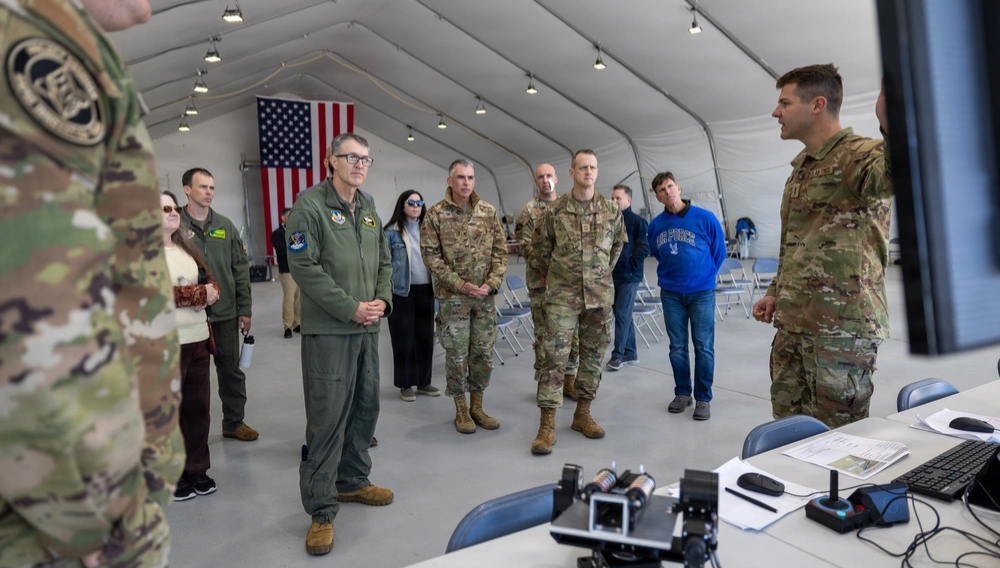
*Image: www.dvidshub.net/image/9470902/edwards-launches-game-drones-help-deliver-drone-dominance-warfighter The appearance of U.S. Department of Defense (DoW) visual information does not imply or constitute DoW endorsement.
About the author:

John Breitenbach, Director Aerospace & Defense Markets, RTI
John Breitenbach is Director of Aerospace & Defense Markets for Real-Time Innovations. He has over 30 years of experience designing software for intelligent machines. He’s worked on industrial, medical, consumer and military products – everything from artificial hearts to autonomous vehicles to elevators.