 Success-Plan Services
MedTech Reference Architecture
Developing your Next-Generation MedTech Systems with RTI Connext

Introduction
The Medical Reference Architecture demonstrates RTI's best practices for building medical devices using RTI Connext. This repository contains documentation and modules showcasing different capabilities of Connext in a Medical context. The goal is to provide a comprehensive guide to help developers leverage Connext for building robust, scalable, and interoperable medical systems.
RTI Connext is a leading connectivity framework designed to facilitate real-time data distribution in distributed systems. In the medical field, it is crucial to have reliable and timely data exchange between various medical devices and systems. This Reference Architecture aims to illustrate how Connext can be used to build a robust Medical Reference Architecture that ensures data interoperability, scalability, and reliability.
By following the examples and best practices outlined in this documentation, architects and developers can find inspiration to create medical applications. The full Capability Brief for this reference architecture can be found here, along with a high-level video walkthrough of this example.
-
What This Reference Architecture Does
Module 1: Surgical Robotics
The first module in this reference architecture exemplifies a very simple crossover between RTI Shapes Demo and a surgical robot. It is made up of 5 components:
- Orchestrator: A GUI application that helps the user control the system, while showing you the status of the other applications in the system.
- Arm Controller: A GUI application that helps the user control the robotic arm, sending it commands.
- Arm: A GUI application that displays the angles of the different joints and simulates the movement of the robotic arm.
- Patient Sensor: A command-line application running in the background that sends randomly- generated vital signals to the Patient Monitor.
- Patient Monitor: A GUI application that displays the vital signals sent by the Patient Sensor.

Module 2: Recording / Replay ServiceThis module showcases how to use RTI Recording Service to record the data from module 1. Then, it demonstrates how to use RTI Replay Service to replay the recorded data. These two services can be used as powerful tools for:
- Recording live data for post-mission analysis
- Replaying for testing and simulation purposes
- Achieving regulatory compliance
- Running performance verification
- Completing data logging

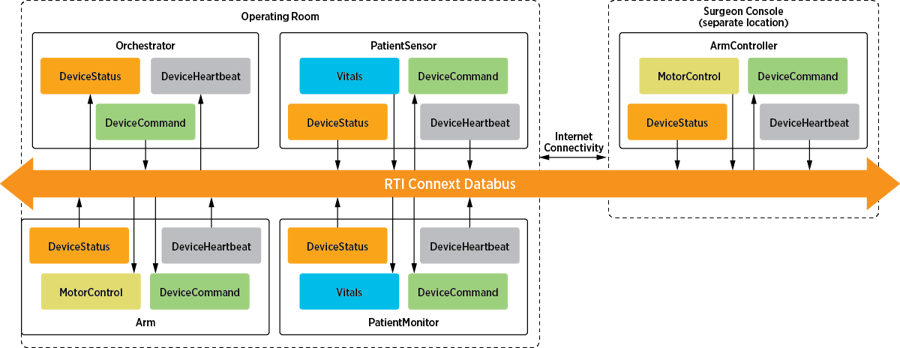
Module 3: Remote Teleoperation with RTI Real-Time WAN TransportThis module demonstrates teleoperation across the Wide Area Network (WAN) using the RTI Real-Time WAN Transport. This transport plugin enables DDS communication across the WAN using UDP as the underlying transport-layer protocol.
The module shows how the Surgeon Console from 'Module 1: Surgical Robotics' can be located anywhere in the world and continue to communicate with the rest of the system. This module showcases:
- Low-latency communication across WAN connections
- Automatic NAT traversal capabilities
- Secure data transmission with built-in authentication, encryption and access control
- Bandwidth optimization for efficient data transfer (when compared to TCP-based communication)
- Connection resilience with automatic reconnection
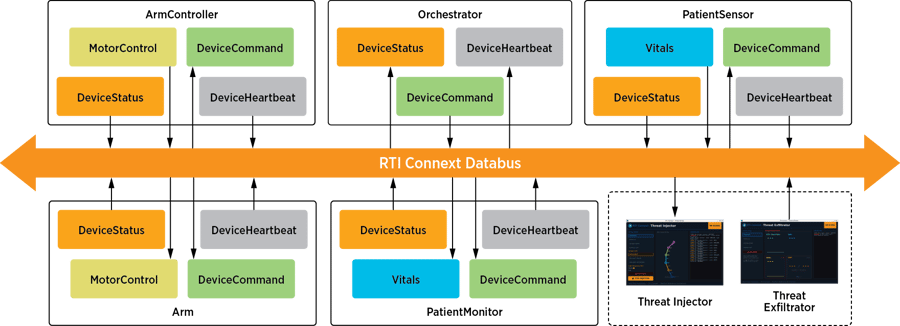
Module 4: Mitigating Security Threats with RTI Security ExtensionsThis module demonstrates how RTI Security Extensions protect data in motion, using "Module 1: Surgical Robotics" as a foundation. It demonstrates how these security measures effectively block threats such as command injection and data exfiltration that could otherwise succeed when security is not enforced.
This module illustrates the following security concepts:
- Certificate-based authentication
- Access control enforcement
- Discovery encryption using Pre-Shared Keys (PSK)
- Data encryption using Public-Key Infrastructure (PKI)
-
Building the Example
The RTI MedTech Reference Architecture currently supports Linux and MacOS platforms.
Please follow the Quick Start section in the repository README file for the specific instructions. Here are the abbreviated 5-step instructions:
-
Install dependencies
- Clone the repository:
git clone https://github.com/rticommunity/rticonnextdds-medtech-reference-architecture.git - Set up Python virtual environment
- Build module applications
- Generate security artifacts (optional)
-
-
Running the Example
The RTI MedTech Reference Architecture modules showcase usage and capabilities of the provided system architecture.
RTI recommends following the module-specific READMEs to run the corresponding applications.
Module 1: Digital Operating Room
Module 2: RTI Recording Service & RTI Replay Service
Module 3: Remote Teleoperation with RTI Real-Time WAN Transport
-
Summary
These simple code examples show how to apply Connext to a range of MedTech use cases, from patient monitoring to surgical robotics as well as how to integrate security into an existing Connext system.
-
Next Steps
Post questions on the RTI Community Forum.
Check out more of the Connext product suite and learn how Connext can help you build your distributed system. If you haven't already, try Connext for free.